



advanced plant care, Garden to Table, Gardening, General Plant Care Guides, plant care, plant science, Plants and Wellness, podcast
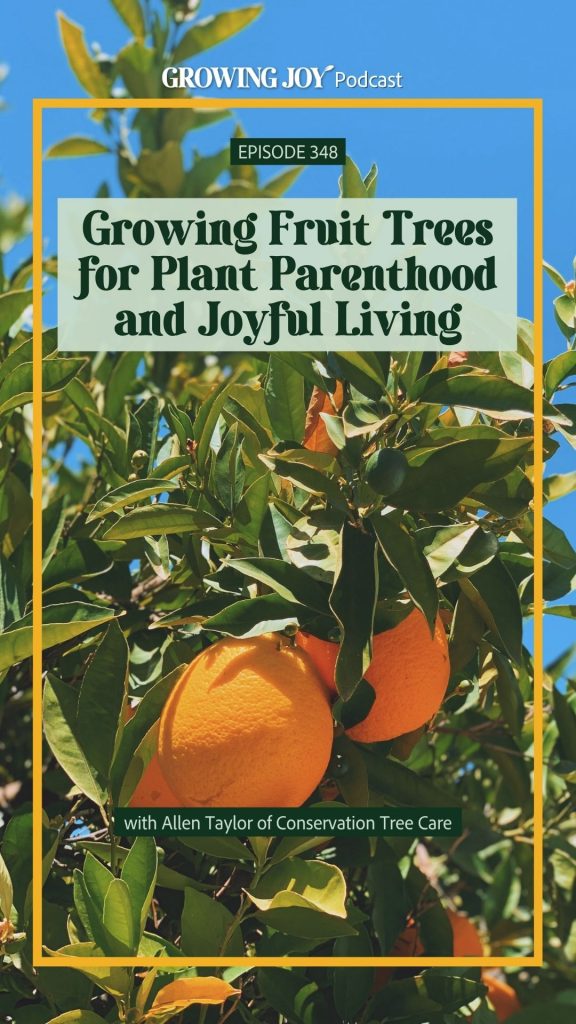
Growing Fruit Trees for Plant Parenthood and Joyful Living with Allen Taylor of Conservation Tree Care, Ep 348
Don't forget to subscribe to the podcast
What if your backyard could feed you for decades with way less work than a tomato patch? You can achieve this with fruit trees! I met arborist Allen Taylor at the Northwest Flower and Garden Show earlier this year. He's the founder of Conservation Tree Care, and he shares how to grow fruit trees in your own backyard with confidence and patience. I'm a homeowner now, and I am so excited to finally have fruit trees of my own! Let's dive in!
In this episode, we learn:
- [01:52] Meet Allen Taylor, founder of Conservation Treecare!
- [02:17] What is forestry, and how did Allen get into it via a college course?
- [03:22] How arboriculture differs from forestry (individual trees vs. whole ecosystems)
- [04:45] The Overstory and tree climbers who work up in the canopy
- [09:37] How his passion for large trees relates to small fruit trees
- [10:51] Seattle's century-old orchard trees!
- [12:32] What are the two starting points for fruit trees? (assessing a bare site vs. inheriting mature trees already there)
- [14:07] Why you also have to think about harvest volume you can handle
- [15:02] Check out The Essential Guide to Ecological Gardening by the American Horticultural Society!
- [16:17] Set your fruit trees up right from planting with Espoma Organic!
- [18:21] Why it's okay to treat a fruit tree as a low-maintenance shade tree (that happens to fruit)
- [19:38] What makes something an “orchard” vs. just having a tree?
- [22:30] Why fruit exists (spreading seeds) and how domestication changed fruit itself
- [24:10] Fruit tree timeline! What age of wood trees fruit on?
- [26:55] Which fruit trees are most popular by region, and why local zone/climate matters so much?
- [29:19] Why local extension services and nurseries beat big box stores for picking trees
- [31:41] What does the yearly care for fruit trees look like (pruning, planting, harvest windows)?
- [34:17] Planting and transplant shock!
- [35:52] Fruit trees planting basics: hole size, soil, mulch, watering to establishment
- [39:03] Sun and site selection (full sun, flat ground, and thinking about ladder access)
- [42:38] Why you should prune fruit trees compared to other edibles
- [43:58] Why does dormant pruning work with the tree's stress response?
- [46:14] Should you remove blossoms in year one, or just leave the tree alone and wait?
- [47:33] Pruning vs. training explained
- [48:59] Pruning intensity tips
- [52:10] What are the top beginner mistakes you commit with trees?
- [57:10] The 3 types of pruning cuts (removal, reduction, heading) and how the tree responds to each
- [59:06] Why fruit trees are a great gateway into caring about trees generally
- [59:51] Allen's favorite fruit tree and the joy of sharing homegrown harvests with neighbors!
- [1:01:33] Where to find Allen, Conservation Treecare, and his work at the Amazon Spheres
Order my book!
Growing Joy: The Plant Lover's Guide to Cultivating Happiness (and Plants) by Maria Failla, Illustrated by Samantha Leung
What Is a Backyard Orchard?
I think people overthink it. Do two plum trees count? Do you need twelve?
Allen says that he doesn’t like rules, and nature doesn’t either. If you have a tree and it makes fruit, you can call it an orchard.
One term worth knowing though is species vs. cultivar. Species is the broad category, like “apple tree.” A cultivar is more like a specific breed, like Honeycrisp vs. Gravenstein apple.
There are really two paths in:
- Starting from scratch, picking a site based on sun and your free time
- Inheriting trees, which Allen says is actually more common
Note: an inherited tree can just be a hands-off “shade tree that happens to produce fruit”.
Why Pollination Matters for Fruit Trees
Most people obsess over pruning, but pollination is what you should be focusing, as mentioned by Allen.
Some trees, like fig, are self-fertile and can produce fruit on their own. But most fruit trees need a nearby tree to fertilize them, or you won't get fruit at all. Even self-fertile trees tend to produce better fruit with a pollinator partner nearby.
But it all depends a lot on where you live. In cities like Seattle, there are so many fruit trees around that pollination usually just happens naturally. Out in rural areas, you may need to plant two compatible trees yourself.
Note: weather matters too. A cold snap during bloom week can keep pollinators away entirely.
How Long Does It Take for a Fruit Tree to Fruit?
Fruit trees are a slow, long-term project, not instant like a tomato plant.
- If you plant a seed, you're looking at 6 to 10 years before you see any fruit (most people don't do this though)
- Instead, you buy a small grafted tree from a nursery (takes 3 to 6 years only)
Fruit only grows on wood of a certain age. For trees like apples and plums, that's usually 2- to 4-year-old wood. So even after your tree survives its first few seasons, the specific branches still need time to mature before they can flower and fruit.
How to Plant a Fruit Tree Correctly
A few key things Allen says to get right from the start:
- Start small: a smaller starter tree adjusts to new soil faster than a large one
- Straighten the roots: roots that circle around in the nursery pot need to be loosened before planting, or they'll keep circling and eventually choke the tree
- Skip the “rich soil” trap: don't create a special pocket of amended soil in the hole and just mix the tree back into the same native dirt you dug out.
- Mulch it: a 4-inch layer of wood chips protects the soil and slowly feeds the tree
- Water deeply, weekly: do this for the first 1 to 3 years while roots establish
Get a soil test before adding fertilizer. Too much can actually stress out a young tree instead of helping it.
Most fruit trees also want full sun and relatively flat, easy-to-reach ground, since orchards traditionally grow in open, unshaded farmland.
How to Prune Fruit Trees
Fruit trees tolerate heavy pruning far better than ornamental trees, sometimes up to half the tree's growth is removed in a season, something you'd never do to a maple or fir.
A few basics to know:
- Prune in winter, when the tree is dormant and its energy is stored safely in the roots and trunk
- Removal cuts take off a whole branch at its base
- Reduction cuts trim back to a smaller side branch, keeping growth controlled
- Heading cuts chop mid-branch, but tend to cause messier, bushier regrowth
Popular Fruit Trees to Consider
Your best fruit tree pick really depends on where you live! In Seattle, where Allen works, the most common backyard choices are:
- Apple
- Plum
- Fig
He notes Seattle's long growing season, rich soil, and warm dry summers make it especially forgiving for fruit trees, and some clients there even grow olives.
Down here in Florida, my neighbors' yards are full of mango trees, and I've even got a coconut tree in my own backyard.
Note: Allen's best advice is to check with local nurseries or your state's extension office rather than relying on big-box stores, since what grows well varies so much by region.
Plant Your Next Fruit Tree!
Fruit trees are a generational investment rather than a quick garden project, so that means you're not planting for this summer. You're planting for years down the road.
Start small and pick the right tree for your zone. I'm genuinely so excited to finally plant fruit trees in my own Florida backyard now that I'm a homeowner!
Mentioned in our conversation:
Thank you to our episode sponsors:
Quarto: Essential Guide to Ecological Gardening by The American Horticultural Society
Deepen your understanding of your garden as a living system with the Essential Guide to Ecological Gardening! Learn how small, thoughtful gardening choices can result in a healthier and more resilient garden with this comprehensive book. It talks about building better soil, conserving your water, supporting pollinators, and making plant choices that actually fit your landscape and local wildlife, and many more. Make your gardening more gentle on the planet and more rewarding for you!
Grab the Essential Guide to Ecological Gardening at quarto.com and wherever books are sold.
Espoma Organic
As we gear up for the garden season, don't forget to give your garden only high-quality organic products! Espoma Organic is dedicated to making safe indoor and outdoor gardening products for people, pets, and the planet. They have an amazing variety of high-quality, organic potting mixes, garden soil, fertilizers, and pest control products that are organic and eco-friendly. To top it all off, they have a huge sustainability commitment with a 100% solar-powered plant, zero waste manufacturing, and eco-friendly packaging.
Visit espoma.com to find your local Espoma dealer or check my Amazon storefront.
ZenAI
Turn your everyday conversations into a podcast with ZenAI! Just hit record on your phone, have a great conversation, and ZenAI's AI Producer automatically handles the editing, clips, and distribution for you. From recording to publishing to promoting on social media, ZenAI does the heavy lifting so you can focus on what you actually enjoy: talking. And with built-in monetization tools like brand deals and affiliate marketing, you can start earning from your very first episode.
Visit zen.ai to start your first vibecast for free.
Follow Allen:
Follow Maria and Growing Joy:
Order my book: Growing Joy: The Plant Lover's Guide to Cultivating Happiness (and Plants) by Maria Failla, Illustrated by Samantha Leung
Take the Plant Parent Personality Quiz (Get the perfect plants, projects and educational resources for YOUR Lifestyle)
Support Growing Joy with Maria by becoming a Plant Friend on Patreon!
Instagram: @growingjoywithmaria
Tiktok: @growingjoywithmaria
Subscribe to the Growing Joy YouTube channel! /growingjoywithmaria
Website: www.growingjoywithmaria.com
Pinterest: @growingjoywithmaria

Leave a Reply
You must be logged in to post a comment.