
Gardening, General Plant Care Guides, Lifestyle, Nerdy Science Breakdowns, plant care, Plantside Chats: Life Lessons Learned in the Garden, Planty People
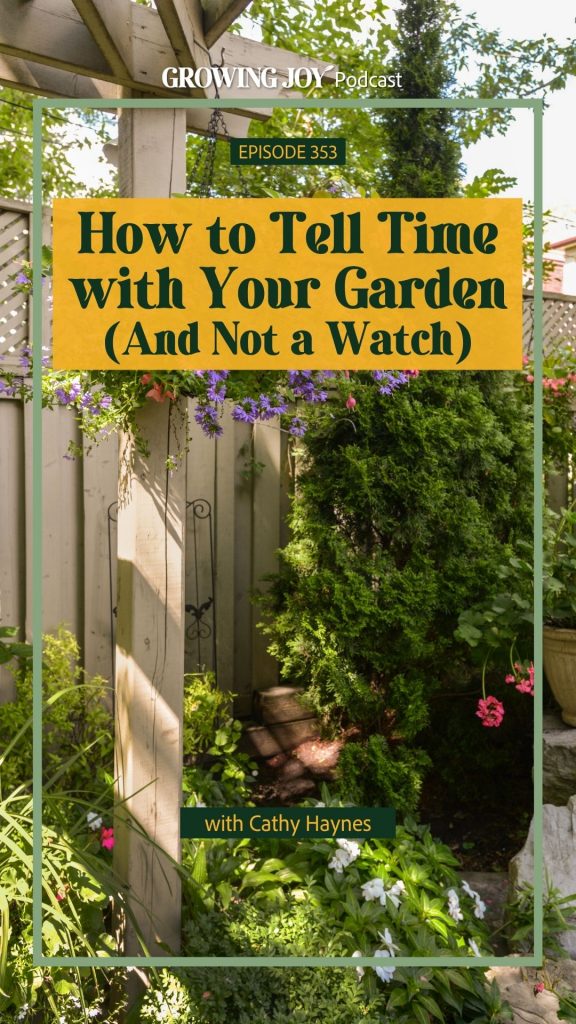
How to Tell Time with Your Garden (And Not a Watch) with Cathy Haynes, Ep 353
Don't forget to subscribe to the podcast,
Is it possible to tell time with your garden? Apparently, birds and plants can tell us what time of day it is! When we recorded this episode, I was in my third trimester, so sometimes I would be up at 2 AM whether I liked it or not. Which was how I found out that the birds in my Florida backyard start up around 4! For a while, I'd check my phone to see how close we were to sunrise. Now I learned to listen. That's the idea behind The Fullness of Time by Cathy Haynes. It's a book I read about how to tell time without a clock, instead using birdsong, blooms, shadows, and stars. It touched the gardener in my soul, and I knew I needed to have Cathy on the podcast to talk about all of the different ways our ancestors kept time in their gardens and in nature. Come learn with me!
In this episode, we learn:
- [02:07] Meet Cathy Haynes!
- [03:12] What is The Fullness of Time book about?
- [04:05] The evening primrose in her London backyard that started all of this!
- [05:55] How does gardening change your sense of time?
- [07:17] How did ordinary people tell time before clocks? (sticks, shadows, and their own bodies)
- [09:26] Cock crow, midnight spirits, and what each part of the day means!
- [11:42] Reading a clock vs. actually sensing time
- [12:20] What is the ornithological clock (how to tell time through birds)?
- [15:24] Give your plants a boost before the season winds down with Espoma Organic!
- [17:00] Learning to pick out the individual singers in the dawn chorus
- [17:36] Have you tried using the Merlin app to learn birdsong?
- [18:38] What third-trimester insomnia taught me about the 4 AM birds
- [19:47] Why noticing nature's rhythms doesn't require slowing down
- [21:53] What is this Linnaeus’s flower clock?
- [23:55] Did the Bern Botanical Garden get a living flower clock to work?
- [26:30] Daisies, chicory, and the timekeeping plants hiding in pavement cracks
- [28:40] Which time-telling plants can you add to your own garden?
- [30:59] Why mature sunflowers stop following the sun and just face east
- [33:26] How did our ancestors use shadows to tell time?
- [35:21] Ancient scratch sundials on churches and Icelandic hills!
- [37:37] Light pollution and how to adapt to the sun in a city
- [39:32] Can you tell the time by the stars?
- [41:42] What are some simple ways to get started with your time garden?
- [44:52] Where to find Cathy and The Fullness of Time!
Order my book!
Growing Joy: The Plant Lover's Guide to Cultivating Happiness (and Plants) by Maria Failla, Illustrated by Samantha Leung
What Is Telling Time by Nature?
Before clocks, people read the day from the world around them:
- the slant of a sunbeam
- the length of a shadow
- birds
Farm workers started before dawn, but not until cock crow. There's also a medieval rule from Paris for one of the craft guilds that work begins when you can recognize faces in the street.
Cathy found versions of that same measure in cultures all over the world.
The Ornithological Clock: What Time Do Birds Start Singing?
According to Cathy’s research, a German woodsman in the mid-1800s claimed he had built an ornithological clock, where his birds sang at exact half-hour intervals.
Well, wild birds are not that punctual. But modern ornithology does support a predictable dawn sequence: birds that see better in darkness sing first.
- European robin
- Blackbird
- Skylark
- Then wren, bluetit, chaffinch, and dunnock
Those are Cathy's birds in London. Yours will be different. Your clock is your own.
Cathy’s learning to pick out individual singers by when they come in and when they drop away. She's also honest that it won't get her to the train on time.
Note: The Merlin Bird ID app is how I learned mine. Sit outside, let it listen for a couple of weeks, and eventually you won't need it.
The Floral Clock: Flowers That Open and Close by the Hour
Most gardeners know Carl Linnaeus as the plant Latin/taxonomy guy. But turns out he was also a bit of a clock nerd!
In the 1740s, he started timing when flowers opened, and he published 40 of them with their hours in Philosophia Botanica. He claimed a floral clock could be worked out for any climate.
Cathy said he probably never grew one himself, though. But in 2022, Sylvain Aubry at Bern Botanic Garden did, in crescent-shaped plots. After two summers of testing, it more or less worked from May to September… daylight hours only.
Flowers that keep time:
- Daisy
- Chicory
- Purple shamrock
- Morning glory
- Goat's beard
- Calendula
- Four o'clocks
Do Sunflowers Actually Follow the Sun?
When my mom lived in New York, she planted 300 sunflowers in her front yard, and I watched them swing east to west every day. It was one of the best parts of that summer.
Except that's not quite what was happening.
According to Cathy’s research, the fully mature flower doesn't move. It's the immature bud that tracks the sun.
Once the flower opens, it settles facing east, toward sunrise, and stays there. The theory is that it warms up faster in the morning, which makes it a more inviting stop for bees.
So the next time you drive past a sunflower field, you know which way you're looking!
Reading Shadows, Twilight, and Stars
Gardeners already think in shadows, like where the sun falls or where the shade sits.
Midday is the easiest hour to read. At noon, your shadow points north to south, and it's at its shortest. And the length shifts with the season, so it tells you more than just the hour.
Early settlers in North America even carved a midday line into a porch or a windowsill to mark that spot, and some old houses still have them.
Then at night, Cathy picks out Orion's Belt from her parking lot in bright, overlit London.
Start with One Thing
Cathy's advice for beginners on how to start is… whatever takes your fancy. Pick one plant and watch when it opens. Or step outside for the dawn chorus!
Mentioned in our conversation:
- The Fullness of Time: Marking the Day by Birdsong, Blooms, Shadows, and Stars by Cathy Haynes
- Merlin Bird ID
- Collins Bird Guide App
- A Botanical Timekeeper – The Flower Clock
- Growing Joy Episode 186: The History of Houseplants with Jane Perrone
Thank you to our episode sponsor:
Espoma Organic
As we slowly approach the new season, give your plants a boost with Espoma Organic's fertilizers! Espoma Organic is dedicated to making safe indoor and outdoor gardening products for people, pets, and the planet. They have an amazing variety of high-quality, organic potting mixes, garden soil, fertilizers, and pest control products that are organic and eco-friendly. To top it all off, they have a huge sustainability commitment with a 100% solar-powered plant, zero waste manufacturing, and eco-friendly packaging.
Visit espoma.com to find your local Espoma dealer or check my Amazon storefront.
Follow Cathy:
Follow Maria and Growing Joy:
Order my book: Growing Joy: The Plant Lover's Guide to Cultivating Happiness (and Plants) by Maria Failla, Illustrated by Samantha Leung
Take the Plant Parent Personality Quiz (Get the perfect plants, projects and educational resources for YOUR Lifestyle)
Support Growing Joy with Maria by becoming a Plant Friend on Patreon!
Instagram: @growingjoywithmaria
Tiktok: @growingjoywithmaria
Subscribe to the Growing Joy YouTube channel! /growingjoywithmaria
Website: www.growingjoywithmaria.com
Pinterest: @growingjoywithmaria

Leave a Reply
You must be logged in to post a comment.