

When Was the Last Time You Had an Original Thought?, Ep 359
Don't forget to subscribe to the podcast,
This might be uncomfortable to ask you, plant friends, but when was the last time you had an original thought? Meaning, it shouldn’t be something you heard from a podcast, Instagram, or even ChatGPT. I’ve been itching to ask this question since coming back from maternity leave. And even when I sat down to write this, I caught myself scrolling, trying to find more about how to stop doing exactly that. This might be a little different from what we always talk about, but I figured it's something we can all have a conversation about. Let's dive in!
In this episode, we learn:
- [02:04] Why is it so hard to hear yourself coming out of maternity leave?
- [04:49] How it's possible to go a whole day without one original thought
- [07:33] What is information overload?
- [08:24] Why do self-help, wellness, and meditation apps sometimes add to information overload?
- [09:56] Why we need space and the ability to get bored again
- [11:40] “Look at a plant before you look at a screen”
- [12:33] How did trading coffee with my phone for coffee with my plants change my mornings?
- [15:35] Have you tried single-origin Manukora honey?
- [17:21] Make fertilizing and mixing chunky soil simple with Espoma Organic!
- [19:21] Why plants are such a gentle place to put your attention
- [20:21] What is attention restoration theory? (Directed vs. involuntary attention)
- [22:36] How a 40-second green roof microbreak improved focus
- [24:35] Why I'm telling you to turn off this podcast…
- [25:55] Check out my Substack!
- [26:14] Back to the original question: when was the last time you had an original thought?
Order my book!
Growing Joy: The Plant Lover's Guide to Cultivating Happiness (and Plants) by Maria Failla, Illustrated by Samantha Leung
Is It Possible to Go an Entire Day Without an Original Thought?
Okay, first of all, I’m not judging you because I’m similar. Our normal day usually starts by getting woken up by our phone alarm, and when we grab it, we see all those tasty apps right there.
We check our email, maybe do a quick scroll, or listen to a podcast while we make coffee.
And the in-between moments fill up too. We scroll in the bathroom, the coffee line, the waiting room.
I've even felt the urge to scroll while breastfeeding Polpettino when that should be one of the most sacred moments of my day!
And the cycle starts again.
What Is Information Overload? (And Why More Self-Help Won't Fix It)
Information overload happens when we consume more information than we can process.
It leads to:
- Stress
- Cognitive strain
- Trouble making decisions
- Lower productivity
The irony is that when we feel bad/burnout, we look for more inputs instead of slowing down. We read the self-help book, follow the wellness guru, and download the meditation app.
It's a “spinning wheel of inputs”. Information can be given to you, but wisdom and intuition have to be grown with space and time.
Remember Being Bored? Why Your Best Ideas Come in the Shower
Have you ever tried reading the back of the shampoo bottle? Or walking somewhere with nothing in your ears?
That time isn’t necessarily ‘empty.’ It's where the good ideas come from.
Glennon Doyle (author of bestselling books like Untamed and Love Warrior) once told her kid that, of course, their best ideas come in the shower because it's the only time they're not listening, reading, or scrolling.
Look at a Plant Before You Look at a Screen: A Simple Phone-Free Morning Routine
I personally think the fix is simpler than we expect. It's a practice called ‘Look at a Plant Before You Look at a Screen,' the first chapter of my book and the one readers write to me about most.
It’s ideal to do this in the morning.
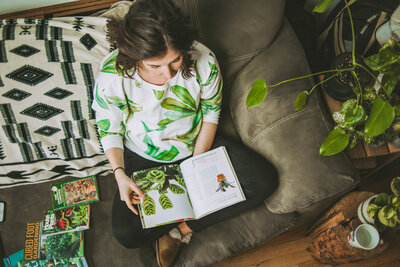
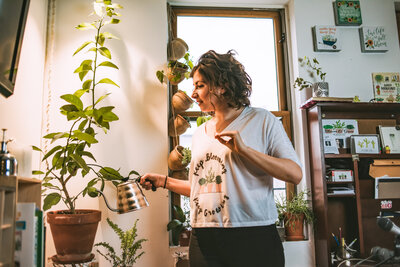
I used to have coffee with my phone. Now I have coffee with my plants, and I'm so much happier! So I look at their leaves and feel their soil. In forest therapy, we call this ‘being with a being’.
And you don't need:
- An app
- A two-hour morning routine
- Waking up at 5 a.m.
- A cold plunge
Plants Don't Have Hot Takes: Attention Restoration Theory
Part of why this works is that plants don't have hot takes. I know it sounds weird, but this means your photos aren't trying to hand you a 7-step plan to become your highest self, or your monstera isn’t trying to optimize you.
There's research behind this too! Attention restoration theory says we have two kinds of attention.
Directed attention is focus, like emails and scrolling. We only have so much of it before we feel drained.
Involuntary attention is effortless, like watching clouds drift by. Most of us live in directed attention all day, so we burn out, and nature is there to give us a way back.
What 40 Seconds of Green Can Do for Your Focus
In the 2015 Green Roof study, 150 university students did a focus task designed to drain their attention.
They took a 40-second break, were shown a simulated picture of different roofs, then did the task again.
Half saw a plain concrete roof, and the other half saw a green roof covered in plants.
The green roof group made fewer errors and responded more consistently.
So 40 seconds is a great place to start to appreciate nature/plants!
Close This Tab and Go Be With a Being
For the next seven days, try two things:
- Look at a plant before you look at a screen every morning
- Take one beat/pause during the day before reaching for your phone
When was the last time you had an original thought? Maybe you can't remember. The goal for this task isn’t to shut out the world but to make a little room to be with yourself because your attention belongs to you.
I'd love to hear how your seven days go. Also, I’m inviting you to subscribe to my newly launched Substack!
Mentioned in our conversation:
- Growing Joy episodes:
- 2015 Study: 40-Second Green Roof Views Sustain Attention
- Subscribe to my Substack
Thank you to our episode sponsors:
Manukora
Swap your artificial sweeteners with single-origin manuka honey! Manukora honey is a rich, creamy honey from the remote forests of New Zealand, ethically harvested and packed with powerful nutrients. It contains triple the antioxidants and prebiotics of regular honey, supporting immunity and gut health. Versatile and delicious, it can be used in coffee, smoothies, smoothie bowls, or enjoyed straight from the spoon for an energy boost.
Go to manukora.com/bloom to get up to 31% off the starter kit that includes their 850+ Manukora honey jar, 5 honey travel sticks, a wooden spoon, and a guidebook, PLUS $25 worth of free gifts!
Espoma Organic
If you want simpler and safer plant care, Espoma Organic has your back with their organic soil, fertilizers, and compost! Espoma Organic is dedicated to making safe indoor and outdoor gardening products for people, pets, and the planet. They have an amazing variety of high-quality, organic potting mixes, garden soil, fertilizers, and pest control products that are organic and eco-friendly. To top it all off, they have a huge sustainability commitment with a 100% solar-powered plant, zero waste manufacturing, and eco-friendly packaging.
Visit espoma.com to find your local Espoma dealer or check my Amazon storefront.
Follow Maria and Growing Joy:
Order my book: Growing Joy: The Plant Lover's Guide to Cultivating Happiness (and Plants) by Maria Failla, Illustrated by Samantha Leung
Take the Plant Parent Personality Quiz (Get the perfect plants, projects and educational resources for YOUR Lifestyle)
Support Growing Joy with Maria by becoming a Plant Friend on Patreon!
Instagram: @growingjoywithmaria
Tiktok: @growingjoywithmaria
Subscribe to the Growing Joy YouTube channel! /growingjoywithmaria
Website: www.growingjoywithmaria.com
Pinterest: @growingjoywithmaria

Leave a Reply
You must be logged in to post a comment.