


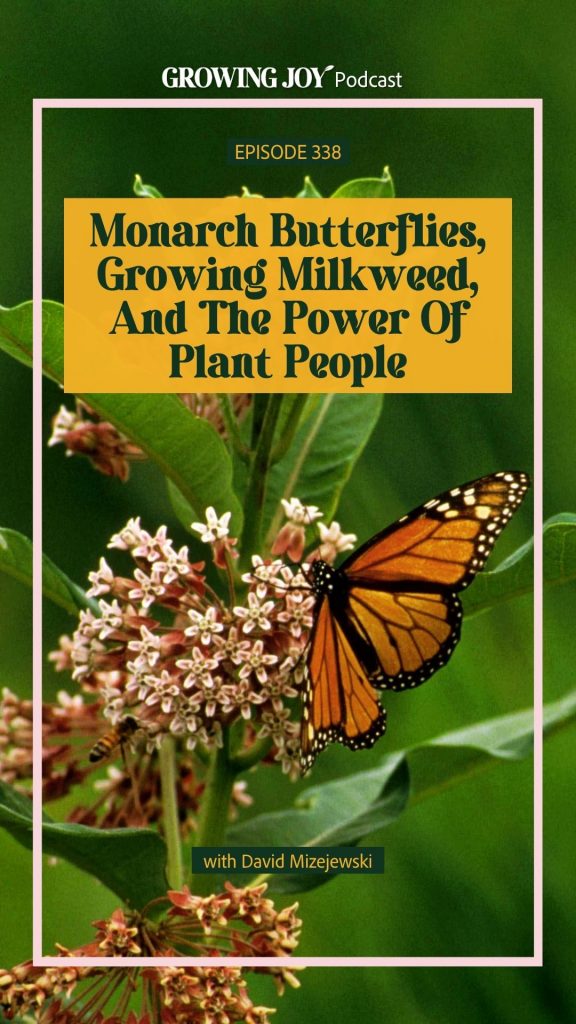
Monarch Butterflies, Growing Milkweed, And The Power Of Plant People with David Mizejewski, Ep 338
Don't forget to subscribe to the podcast,
Why are monarch butterflies so special? If you follow me on Instagram, you already know my answer. The monarch butterfly has completely taken over my heart. I literally dressed up as one for Halloween this year, and I have zero regrets! Ever since my husband and I moved to Florida, I started planting milkweed just to watch them hatch in my own yard. And wow. Seeing their life cycle happen right in front of me made me think deeply about gardening. It also made me realize I had a lot to learn. So I called up my favorite wildlife nerd, David Mizejewski, and we spent a whole podcast episode just geeking out about monarch butterflies together! Let's dive in!
In this episode, we learn:
- [03:57] Meet David Mizejewski, a naturalist, NWF, and a fellow monarch nerd!
- [04:36] Why monarch butterflies hold a special emotional place for me
- [06:06] What are the benefits of monarchs?
- [08:49] Are monarchs really disappearing?
- [10:53] Why the endangered/threatened designation is so confusing (IUCN vs. U.S. Endangered Species Act)
- [12:52] What would a “threatened” listing actually do for monarchs?
- [15:28] Experience single-origin Manuka honey with 3x more antioxidants with Manukora!
- [17:13] How microplastics affect the environment
- [18:25] Why are monarchs disappearing?
- [19:20] The monarch lifecycle and why each phase needs something different
- [22:19] Why monarchs are specialists
- [29:48] How gardeners can actually help monarch butterflies
- [31:33] Native milkweed varieties worth knowing: swamp milkweed, butterfly weed, antelope horns, and more
- [35:12] How to source pesticide-free native plants
- [36:45] What are neonicotinoids?
- [37:37] Which milkweed to avoid (aka the tropical milkweed problem)
- [39:31] How tropical milkweed is disrupting the migration of monarchs to Mexico
- [42:39] How to visually identify tropical milkweed
- [45:05] Why you shouldn’t hand-rear monarchs!
- [48:25] How the monarch migration actually works
- [52:03] What to do instead of hand-rearing!
- [53:43] Why parasitic wasps killing caterpillars is natural
- [55:31] Wildlife need habitat, not a handout
- [57:46] Where to find native plants by zip code
- [59:46] How to certify your monarch garden with NWF
- [01:01:19] My plans for my new home, my HOA, and my neighborhood kids!
- [01:02:35] NWF's “cues of care” strategy
- [01:04:37] Where to find David and all NWF resources
Order my book!
Growing Joy: The Plant Lover's Guide to Cultivating Happiness (and Plants) by Maria Failla, Illustrated by Samantha Leung
Why Monarch Butterflies Are Worth Saving
If monarchs don't pollinate our food crops like bees do, why should we even bother saving them?
Well, David said that monarchs matter because they spark wonder. Plain and simple.
They make us happy. And when we see a lot of them around, it means nature is actually doing okay. So when they start disappearing, that is nature's way of waving a red flag that something is very wrong. And we should be paying more attention.
Understanding the Monarch Butterfly Life Cycle
You can't really help monarchs in your garden without understanding how they grow. Here is how it goes:
- The Egg: An adult butterfly finds a very specific host plant and lays her tiny eggs on it.
- The Caterpillar: All it does is EAT. It grows so fast that it literally busts out of its own skin five times.
- The Chrysalis: Inside this shell, its whole body turns into goo and rebuilds itself into a butterfly!
- The Adult Butterfly: Out comes the butterfly, and now instead of chewing leaves it sips flower nectar through a tiny straw mouth.
Are Monarch Butterflies Endangered?
David said it’s a little complicated but the TLDR is, yes, they are in trouble. The U.S. Fish and Wildlife Service is still working through the legal side of officially listing them under the Endangered Species Act.
But honestly, the label doesn't change what is actually happening out there. Their numbers are dropping fast, and everyone in the science world agrees on that.
Why Are Monarch Butterflies Disappearing?
David shared the three biggest culprits why monarchs are in trouble:
- We are destroying their homes: Giant farms and new developments (like pavements) keep eating up the natural land they need to migrate and breed. Their travel routes are literally disappearing under concrete.
- Pesticides are everywhere: The mosquito sprays kill every single bug they touch (Monarchs, bees, ladybugs). And farm weed killers are wiping out the wildflowers monarchs need to eat.
- Climate change: A random snowstorm in October used to be rare. Now it is not. And those surprise cold can wipe out thousands of migrating butterflies because their tiny wings just cannot handle it.
Why Native Milkweed Is Non-Negotiable for Monarchs
Plants actually evolved toxins in their leaves specifically so bugs would stop eating them. Over thousands of years, though, monarch caterpillars figured out how to handle one specific plant's toxins: milkweed.
And now it is literally the only thing they can eat! So by logic, no milkweed in your area means no monarch babies. Adult butterflies also need lots of different nectar flowers blooming throughout the whole season. So your yard really does need to support both parts of their life.
Which Milkweed Is Best for Monarchs?
Milkweed has the worst branding in the entire plant world. The word “weed” is doing so much damage to its reputation, and it is completely undeserved. There are over 70 native species, and a lot of them are very beautiful:
- Swamp milkweed has delicate, smoky pink flowers that smell like mild chocolate.
- Butterfly weed is great for dry yards.
- Antelope Horns is for my desert Southwest friends!
No matter where you live in the US, there is almost certainly a native milkweed that belongs in your exact region. Check out Garden for Wildlife online because they have done all the homework for you.
The One Milkweed You Should Never Plant
Tropical milkweed. I know it looks pretty and it is everywhere at big box stores, but please leave it on the shelf.
In warm climates, it never dies back in winter, which confuses butterflies into stopping their migration early to lay eggs instead of flying south.
It also holds onto parasites that spread through the whole population and make them weaker over time. So, not worth it.
Should You Raise Monarch Butterflies Indoors?
I know it seems like the most loving thing you can do. But David shared that it actually does more harm than good.
Butterflies raised indoors tend to be weaker flyers and are way more likely to spread disease through wild populations when released.
So the better thing to do is to build great habitat OUTSIDE and just watch it happen naturally.
How to Build a Monarch Butterfly Habitat at Home
A few pots on a porch count. A small raised bed counts. It all adds up. Here is where to start:
- Stop using broad-spectrum bug sprays, especially the mosquito fogger services
- Plant native milkweed for the caterpillars
- Add a variety of nectar flowers that bloom from spring through fall for the adult butterflies
One garden alone won't save the species. But yours plus your neighbor's plus your whole street should move things at scale. I really hope you try this because there’s nothing quite like spotting your first monarch caterpillar on a plant you grew yourself!
Mentioned in our conversation:
- National Wildlife Federation
- Native Plants Finder
- Garden for Wildlife
- Native Plant Finder by Zip Code
- Certified Wildlife Habitat
Thank you to our episode sponsor:
Manukora
Swap your artificial sweeteners with single-origin manuka honey! Manukora honey is a rich, creamy honey from the remote forests of New Zealand, ethically harvested and packed with powerful nutrients. It contains triple the antioxidants and prebiotics of regular honey, supporting immunity and gut health. Versatile and delicious, it can be used in coffee, smoothies, smoothie bowls, or enjoyed straight from the spoon for an energy boost.
Go to manukora.com/bloom to get up to 31% off the starter kit that includes their 850+ Manukora honey jar, 5 honey travel sticks, a wooden spoon, and a guidebook, PLUS $25 worth of free gifts!
Follow David:
Website
Instagram
YouTube
Facebook
TikTok
LinkedIn
Follow Maria and Growing Joy:
Order my book: Growing Joy: The Plant Lover's Guide to Cultivating Happiness (and Plants) by Maria Failla, Illustrated by Samantha Leung
Take the Plant Parent Personality Quiz (Get the perfect plants, projects and educational resources for YOUR Lifestyle)
Support Growing Joy with Maria by becoming a Plant Friend on Patreon!
Instagram: @growingjoywithmaria
Tiktok: @growingjoywithmaria
Subscribe to the Growing Joy YouTube channel! /growingjoywithmaria
Website: www.growingjoywithmaria.com
Pinterest: @growingjoywithmaria

Leave a Reply
You must be logged in to post a comment.