




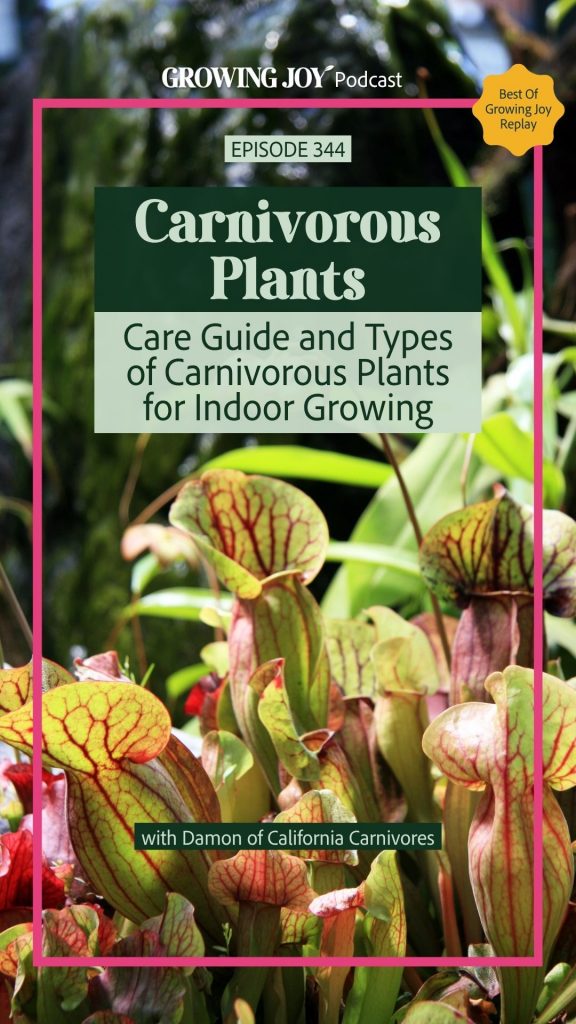
Carnivorous Plants: Care Guide and Types of Carnivorous Plants for Indoor Growing with Damon of California Carnivores – Best of Growing Joy Replay, Ep 344
Don't forget to subscribe to the podcast,
We’ve likely all had some run-in with a carnivorous plant. I brought one of those little Venus flytraps home from the hardware store, even though I had no idea how to care for it. Maybe you have marveled at the wide array of these plants at your local botanical garden. Or maybe you just know the man-eating Audrey II from Little Shop of Horrors! However you found them, you have probably figured out that these plants are in a league of their own. Proper carnivorous plant care is incredibly specific. They are a whole subsect of plants, and they might just get you if you do not care for them correctly. So I invited Damon from California Carnivores to help. He is a carnivorous plant expert (learned from Peter D'Amato) and is going to teach us everything we need to know to grow them indoors! Let's jump in!
In this episode, we learn:
- [02:35] Damon’s history with carnivorous plants
- [07:28] What are carnivorous plants? What makes up a carnivorous plant?
- [13:25] Where to find carnivorous plants in the wild
- [16:33] Why conservation of carnivorous plants is a must
- [19:01] How long have carnivorous plants been around?
- [20:09] Damon shares what he thinks of Little Shop of Horrors musical
- [22:07] General care rules for growing carnivorous plants indoors
- [23:00] The right kind of water for carnivorous plants (and how to identify them in a store!)
- [25:23] How the “tray method” replicates a bog environment at home
- [27:39] The best carnivorous plants to grow indoors (Venus flytrap, pitcher plants, butterworts)
- [31:06] What is the best growing media for carnivorous plants?
- [33:43] Why you shouldn’t use terracotta pots for your carnivorous plants
- [35:00] What’s the ideal sunlight for carnivorous plants (+ grow lights!)
- [37:04] Should you fertilize carnivorous plants?
- [39:31] How to feed your Venus flytrap and Cape sundews
- [41:54] Fertilizing your pitcher plants!
- [44:14 How much humidity do carnivorous plants need?
- [45:22] How to make your Venus flytrap go dormant
- [46:39] Can you fertilize your carnivorous plants even if they’re catching bugs?
- [47:15] Can you overwater sundews and butterworts?
- [48:11] Taking care of your Mexican butterworts
- [49:36] Damon’s recommended beginner carnivorous plants
- [51:03] Should you still buy Venus flytraps even when they’re not sustainably sourced?
- [53:46] Where to find Damon, his book ‘The Savage Garden,’ and nursery resources!
Order my book!
Growing Joy: The Plant Lover's Guide to Cultivating Happiness (and Plants) by Maria Failla, Illustrated by Samantha Leung
What Is a Carnivorous Plant?
To be truly carnivorous, a plant has to do more than just look weird.
There are four very specific rules a plant must follow to join the club:
- It has to lure its prey: most plants use flowers to attract pollinators, but these plants have evolved beautiful leaves to trick bugs. Many even use a nectar lure to attract insects with sugar
- It has to actually catch the bug: there are about 1,000 different species using different methods, like the snap traps of a Venus flytrap or sticky flypaper traps
- It has to digest the insect: they use the same acids and enzymes that animals use to turn a bug into fertilizer
- It can absorb nutrients: the plant pulls nitrogen and potassium into its leaves through special glands
These plants are basically catching their own fertilizer! They still get their sugar from the sun, but they get their “vitamins” from their prey because they grow in nutrient-poor environments.
How to Care for Carnivorous Plants
Water
Damon says the most important rule for indoor carnivorous plant care is skipping the tap water. These plants come from pristine bogs where the water is incredibly pure.
Tap water is full of dissolved salts that never evaporate. So even if you let it sit out overnight, those minerals stay behind and slowly poison the roots.
You have three main options for pure water:
- Distilled water (look for the exact word “distilled” on the bottle)
- Reverse osmosis water (like from the water vending machines at the grocery store)
- Rainwater or melted snow
The best way to water them is using the tray method. Because they naturally grow in bogs, they love to be constantly wet.
Just take your pot and place it in a deep saucer or tray. Fill the tray with a few inches of your pure water, and let the peat moss sop it up like a sponge. Keep them sitting in that water 24/7!
Soil
You need to use a very specific, nutrient-poor soil. Damon said that because they naturally grow in peat and sphagnum bogs, that is exactly what we need to use at home.
The best soil for carnivorous plants is a mixture of peat moss or sphagnum moss. For most outdoor varieties like Venus flytraps and sundews, California Carnivores uses a mix of 4 parts peat moss to 1 part perlite.
Pro tip: Make sure your peat moss or perlite does not have any added fertilizers
Light and Feeding
Carnivorous plants love light! They need a sunny spot indoors (like an east/west-facing window that gets 3-4 hours of sunlight).
For feeding them bugs, if your plants are outdoors for the summer, they will catch plenty on their own.
But indoors, they might need a little help. Sundews and butterworts are incredible at catching the fruit flies and fungus gnats that are already annoying you in your house.
Note: If you do want to hand-feed them, avoid using human food like hamburger meat (a common beginner mistake!). Stick to small, dried bloodworms or tiny live insects.
The Best Carnivorous Plants for Beginners
I realize now that the Venus flytrap is exactly like the succulent of the carnivorous plant world. Everyone thinks they are the easiest plant to care for, but they end up killing them because they actually need very specific environments!
If you want easy carnivorous plants for beginners, skip the flytrap and try one of these instead:
- Nepenthes (Tropical Pitcher Plants): they are at an orchid-level of care. Their pitchers are like “little stomachs” hanging off the ends of their leaves
- Sundews (Drosera): Damon highly recommends the Cape sundew. It is an incredible starter plant that is also a total life-saver if you deal with fungus gnats
- Butterworts (Pinguicula): These are like the African violets of the carnivorous world. They have fleshy leaves that look like succulents but they are actually very effective traps
Damon's passion for high-stakes horticulture is so contagious, and it makes me realize that these plants are incredible relic plants that bring so much joy to a collection!
Mentioned in our conversation:
- The Savage Garden
- Wetlands Reclamation Act
- Osmocote
- Maxsea All-Purpose Nutrient Fertilizer
- California Carnivores YouTube video: Winter Dormancy for Temperate Plants in Cold Climates
Follow Damon:
Website
Instagram
YouTube
TikTok
Follow Maria and Growing Joy:
Order my book: Growing Joy: The Plant Lover's Guide to Cultivating Happiness (and Plants) by Maria Failla, Illustrated by Samantha Leung
Take the Plant Parent Personality Quiz (Get the perfect plants, projects and educational resources for YOUR Lifestyle)
Support Growing Joy with Maria by becoming a Plant Friend on Patreon!
Instagram: @growingjoywithmaria
Tiktok: @growingjoywithmaria
Subscribe to the Growing Joy YouTube channel! /growingjoywithmaria
Website: www.growingjoywithmaria.com
Pinterest: @growingjoywithmaria

Leave a Reply
You must be logged in to post a comment.