


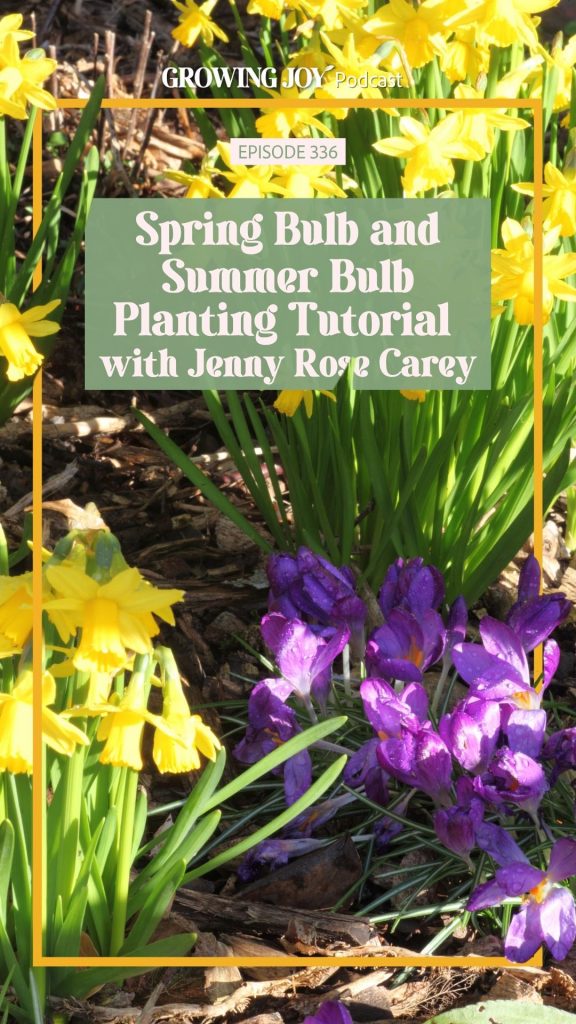
Spring Bulb and Summer Bulb Planting Tutorial with Jenny Rose Carey, Ep 336
Don't forget to subscribe to the podcast,
Did you know that your bulb garden doesn't have to be high-maintenance? One of my earliest memories is my mom planting what felt like endless tulip bulbs—500 of them, in fact. She was a young mom with three kids, no spare time, and definitely not a person who could fuss over plants every day, but somehow, she always had color! Bulbs showed up for her, and she did not have to slave over her garden to get them. That’s why I know it is possible to create a low‑maintenance garden with bulbs. So I invited Jenny Rose Carey on the show to walk us through it. She gardens on a 4.5‑acre property called Northview, filled with thousands of bulbs that bloom from late winter through fall. She’s a horticulturist, a biologist, a teacher at heart, and the author of The Essential Guide to Bulbs. She shares how bulbs actually work, which ones are worth planting, and how to plant them so they don’t rot or disappear after one season! Let's begin!
In this episode, we learn:
- [04:04] Meet Jenny Rose Carey
- [07:05] What’s the history behind her 4-acre garden called Northview?
- [09:57] What a full season of bulbs actually looks like at Northview
- [11:30] What counts as a bulb? (Are dahlias bulbs?)
- [12:43] How the bulb cycle works
- [14:25] Designing a wedding garden with dahlias, raised beds, and containers full of flowers!
- [15:44] Experience the richness of single-origin honey with 3x more antioxidants with Manukora Honey!
- [17:30] How to understand the seasonal lifecycle & dormancy of bulbs (spring bulb vs summer bulb)
- [22:12] How bulbs can create a lower-maintenance garden
- [23:37] What are the best summer bulbs?
- [26:55] Summer bulbs Jenny loves most for flowers and cutting gardens!
- [29:48] Bulb planting 101 (the right depth, tools, orientation, and why you should dig one big hole)
- [33:20] How do you know which way is up/down when planting a bulb?
- [34:32] Why some bulbs seem to “fail” the first year
- [35:48] Why digging one large hole is better than individual holes for your bulbs
- [37:16] What is the drainage rule if you don’t want your bulbs to rot?
- [39:28] In-ground vs. containers for bulbs
- [41:42] How lasagna planting works for bulbs
- [44:39] Where are the best places in your garden to plant bulbs?
- [45:52] What are Jenny’s favorite fragrant bulbs for summer?
- [48:03] The biggest mistakes people make when planting bulbs
- [49:15] How to use store-bought bulbs for instant gratification
- [50:28] Where to find Jenny, her book The Essential Guide to Bulbs, and her garden at Northview!
Order my book!
Growing Joy: The Plant Lover's Guide to Cultivating Happiness (and Plants) by Maria Failla, Illustrated by Samantha Leung
What Is a Bulb?
Most gardeners, myself included, use the word “bulb” pretty loosely. Technically, not all “bulbs” are true bulbs, and if you hang out with other gardeners, they’ll happily tell you the difference.
Some plants grow from:
- tubers
- corms
- rhizomes
And then you’ve got your true bulbs, like tulips and daffodils.
Jenny’s take is that we do not need to get hung up on these terms if we’re just trying to grow a pretty garden. Gardeners “just call them all bulbs” and move on with their lives.
What actually matters is what they do, not what they’re called. Every single one of these “underground storage organs” is designed to store energy under the soil so the plant can survive when life above ground isn’t great.
When the weather turns bad, they simply:
- shut down
- go dormant
- rest
Later, when conditions change and the plant decides it’s “go time” again, it wakes up, pushes through the soil, sends up leaves, and then flowers.
So in practice, the basic story is the same: energy goes down, plant disappears, plant comes back.
Spring Bulbs vs. Summer Bulbs
I realized that bulbs are all about timing, and they’re built to match the seasons, which means the planting and blooming times don’t line up the way we expect.
The main thing with bulbs is that you usually don’t plant them in the same season they bloom. That’s the part that confuses almost everyone at first.
So when we say “spring bulb” or “summer bulb,” we’re talking about when it blooms, and not when you stick it in the ground.
Spring bulbs (tulips, daffodils, hyacinths, crocus)
-
-
- Plant in fall
- They rest underground through winter
- Bloom in spring
- Leaves dies back in summer
- Then they sit dormant until next year
-
Summer bulbs (dahlias, gladioli, cannas, caladiums, lilies)
-
- Plant in spring, after your last frost
- Bloom in summer
- They slow down in fall
- In cold climates, they may need to be dug up and stored before winter
Jenny’s rule of thumb for summer bulbs is if you walk outside and feel like you could sit on the ground, day or night, and feel comfortable, that’s when you can safely put your summer bulbs out.
In her Mid‑Atlantic climate, that lands around Mother’s Day. Though if you’re further south, you’ll probably be out there earlier.
Note: With spring bulbs, resist the urge to tidy too soon. Let the leaves get ugly and die back on their own after blooming, because that messy foliage is how the bulb “refuels” for next year.
How to Plant Bulbs Successfully
I thought planting bulbs meant I needed an auger, a big drill, and some complicated setup.
But Jenny just uses a soil knife for the smaller bulbs and a regular shovel for bigger ones.
Her rule: pointy end up.
If your bulb has a visible tip, that pointed part goes toward the sky, and the rounded, rooty side goes down.
For anemones, where you really can’t tell which side is which, you can just lay them on their side and cover them. They’ll sort themselves out underground.
Plant bulbs about 2 to 3 times as deep as the bulb is tall.
Roughly, that shakes out to:
- Daffodils – about 5 to 6 inches deep
- Tulips – closer to 8 inches deep
- Gladioli – around 5 to 6 inches deep
- Begonias – quite shallow, about 1 inch under the surface
Going deeper actually helps protect bulbs from wild temperature swings and from drying out too quickly at the soil surface.
Instead of digging a hundred tiny individual holes, Jenny suggested digging one larger hole and arranging a group of bulbs inside it.
The Biggest Bulb Mistakes to Avoid
I’ve made a few of these myself, so if you read this list and recognize yourself, please know you are in very good company.
- Planting upside down – whenever you can, go pointy end up
- Overwatering – bulbs rot fast
- Cutting leaves too early – mostly with spring bulbs
- Poor drainage – heavy, wet soil is the enemy
- Planting everything at once
Fragrant Bulbs
We tend to focus on color and shape, but some bulbs also smell incredible, and if you plant them near a path or a door you use every day, they quietly turn those spots into little sensory rituals.
A few of Jenny’s favorite fragrant bulbs:
- Hyacinths
- Lilies
- Tuberose
- Galtonia (often called summer hyacinth)
They’re beautiful to look at, but they also make the air around them richer, which is such an easy way to make your space feel special.
Go Plant Some Bulbs
Bulbs are one of the simplest ways to have a garden that looks gorgeous, feels intentional, and doesn’t eat up your entire weekend. You plant them at roughly the right time, at roughly the right depth, give them water, add a little fertilizer now and then, and then you mostly just wait and enjoy.
They’re doing the complicated part underground, so you don’t have to. I hope that encourages you a little more to grow your own bulbs!
Mentioned in our conversation:
- Growing Joy 150: Bulb Basics with Jenks Farmer
- The Essential Guide to Bulbs by Jenny Rose Carey
- Northview Gardens
Thank you to our episode sponsor:
Manukora
Swap your artificial sweeteners with single-origin manuka honey! Manukora honey is a rich, creamy honey from the remote forests of New Zealand, ethically harvested and packed with powerful nutrients. It contains triple the antioxidants and prebiotics of regular honey, supporting immunity and gut health. Versatile and delicious, it can be used in coffee, smoothies, smoothie bowls, or enjoyed straight from the spoon for an energy boost.
Go to manukora.com/bloom to get up to 31% off the starter kit that includes their 850+ Manukora honey jar, 5 honey travel sticks, a wooden spoon, and a guidebook, PLUS $25 worth of free gifts!
Follow Jenny:
Website
Northview Garden
Instagram
Facebook
YouTube
X
Follow Maria and Growing Joy:
Order my book: Growing Joy: The Plant Lover's Guide to Cultivating Happiness (and Plants) by Maria Failla, Illustrated by Samantha Leung
Take the Plant Parent Personality Quiz (Get the perfect plants, projects and educational resources for YOUR Lifestyle)
Support Growing Joy with Maria by becoming a Plant Friend on Patreon!
Instagram: @growingjoywithmaria
Tiktok: @growingjoywithmaria
Subscribe to the Growing Joy YouTube channel! /growingjoywithmaria
Website: www.growingjoywithmaria.com
Pinterest: @growingjoywithmaria

Leave a Reply
You must be logged in to post a comment.