




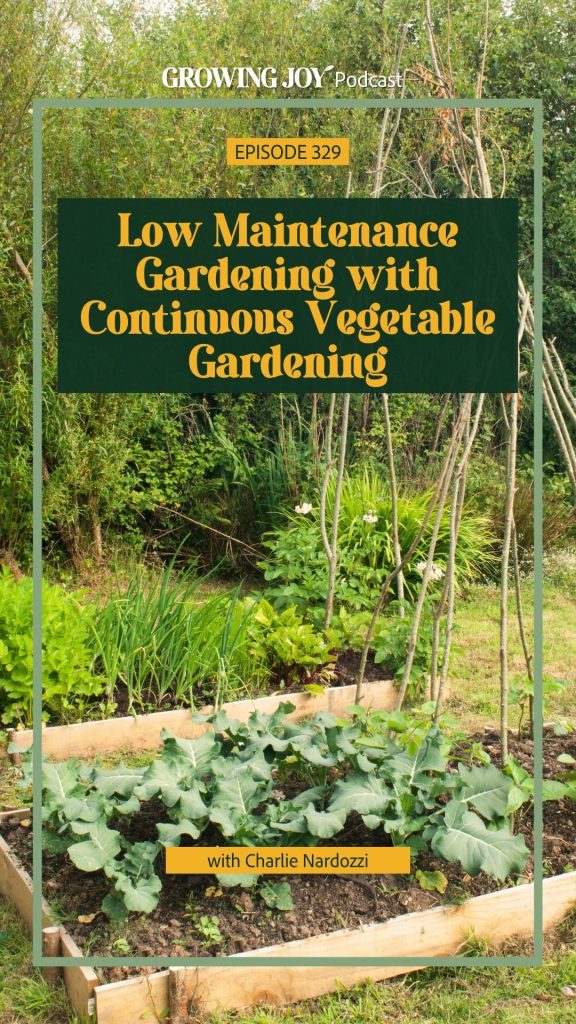
Low Maintenance Gardening with Continuous Vegetable Gardening with Charlie Nardozzi, Ep 329
Don't forget to subscribe to the podcast,
What if you could stretch your season even in cold climates, plant once and harvest for years, and let nature do the lifting? I’ve grown vegetables my whole life, so I know the rhythm. You plant in spring, manage through summer, get so many harvests… and then the garden kind of disappears on you. That model works, and it’s how most of us were taught. If you've grown beans before, you know that. Well, in this episode, I’m joined by horticulturist and author Charlie Nardozzi to talk about his continuous vegetable garden method! He uses perennials, self-sowing plants, and smart succession planting to make the most low-maintenance garden I've ever heard of. And it's more harvest and less work. Let's dive in!
In this episode, we learn:
- [01:27] How Charlie Nardozzi became a continuous vegetable garden expert
- [04:56] What “continuous gardening” really solves
- [05:50] What are self-sowing vegetables?
- [07:51] How I used basil for succession planting!
- [08:28] Manually scattering seeds vs true self-sowing
- [09:40] What perennial edibles are most gardeners overlooking?
- [13:00] Growing wine cap mushrooms as a perennial!
- [14:08] What mulch and organic matter do wine caps need to fruit?
- [14:49] Experience single-origin Manuka honey with 3x more antioxidants from Manukora!
- [16:32] Other ways to grow mushrooms at home!
- [17:02] How your hardiness zone changes what counts as a perennial
- [18:28] What are some of the best self-sowing edibles to start with?
- [19:34] When to let volunteer tomatoes grow and when to pull them
- [20:26] Where seed saving and self-sowing overlap
- [22:10] What Charlie’s garden actually looks like now
- [23:19] No-dig raised beds and mimicking nature for less work
- [24:08] What are Charlie’s favorite plant combinations for a bed?
- [26:14] Can you grow a mostly perennial food garden?
- [27:22] Why Jerusalem artichokes (sunchokes) are an underrated perennial staple
- [29:05] Making garlic and potatoes “perennial” through selective saving
- [30:36] Practical tips for saving seeds, curing garlic, and overwintering tubers
- [32:16] Why labeling matters and how to use mystery seeds
- [32:39] Creating a polyculture bed
- [33:43] Where to find Charlie, his book, and what he's got coming up!
Order my book!
Growing Joy: The Plant Lover's Guide to Cultivating Happiness (and Plants) by Maria Failla, Illustrated by Samantha Leung
What Is Continuous Vegetable Gardening?
Charlie’s not talking about squeezing more plants into a bed, but having a structure.
Most vegetable gardens are built around single crops, like a row of beans or a bed of lettuce. And when they’re done, they’re done. Charlie calls this the boom and bust cycle.
To do continuous vegetable gardening, you think in waves. You layer perennial vegetables in with annuals, and you let certain crops self sow, so they come back on their own. You stagger others with intentional succession planting so everything doesn’t peak at the same time.
It’s still vegetable gardening, but just designed differently. It’s not complicated and is actually simpler long term because there’s less replanting and soil disturbance!
Perennial Vegetables: Plant Once, Harvest for Years
When we think about vegetable gardening, we usually think of annuals. Tomatoes. Peppers. Basil. Things you replant every year.
But perennial vegetables shift that model. They anchor your garden so you’re not resetting everything each spring.
Some examples Charlie shared:
- Asparagus
- Rhubarb
- Egyptian walking onions
- Evergreen bunching onions
- Perennial kale
- Purple sprouting broccoli
- Jerusalem artichokes (sunchokes)
Note: Can you have a mostly perennial food garden? Charlie said yes, but you might have to expand what you think of as food. For example, daily buds, hostas, and herbs!
Planting Self-Sowing Vegetables
Self-sowing is when you let a plant go to seed, the seeds drop to the ground on their own, and then they germinate and grow back without you doing anything.
The idea is that your garden can basically replant itself, especially if you're trying to keep things low maintenance.
Some of the easiest ones he mentioned:
- Lettuce
- Arugula
- Mustards
- Dill
- Calendula
- Nasturtiums
You can be hands-off and just let the seeds fall where they want. Or you can cut a seed head off and move it to a different bed where you want that plant to grow next season. Charlie called it becoming a “garden editor.”
Just keep in mind that some plants, like calendula, will self-sow a lot. If you don't want them taking over, deadhead the flowers before they go to seed.
Succession Planting and Companion Planting
Succession planting just means you don’t plant everything at once.
A lot of new gardeners will plant a full row of beans in May. Sixty days later, they get a ton of beans for a week or two. And then that’s it. The row is done.
Instead, you stagger it.
- Plant a row of beans
- Two or three weeks later, plant another row
- Then another after that
Now you’re not harvesting everything at once, but you’re stretching it out.
Charlie's favorite bed combination is beans, kale, and edamame all in one raised bed:
- Beans go in first and grow up fast
- Kale sits in the middle, protected and just hanging out
- Edamame goes on the other side
Both beans and edamame are legumes, so they're fixing nitrogen into the soil the whole time they're growing.
Once the beans finish producing, Charlie chops them down and leaves them right there on the ground as mulch. Same thing with the edamame a few weeks later. By then, it's late summer, the kale has all that nitrogen, all that space, and cooler temperatures.
He also does what he calls a polyculture bed. You plant your tomatoes, and then in between them you scatter whatever old seeds you have lying around. Like arugula, Asian greens, basil. A month later, you're eating salads from the same bed your tomatoes are growing in!
No-Dig Gardening and Soil
A big part of making a low-maintenance garden work is soil health. Charlie practices no-dig gardening.
He doesn’t till every year but leaves the soil structure alone and adds compost on top. So at the end of the season, if a plant is healthy, he chops it down and leaves it as mulch. In spring, he adds compost and plants right through it.
Over time, that builds stronger soil and supports everything else: the perennials, self-sowing plants, etc. All of it works better when you’re not constantly disturbing the soil.
Start Your Low-Maintenance Vegetable Garden
The continuous vegetable garden is about setting things up so the garden does more on its own! So you still plant tomatoes or grow your favorites, but you build in perennials, stagger others, and let some crops reseed themselves.
If you want to go deeper into Charlie's method, check out his book: The Continuous Vegetable Garden!
Mentioned in our conversation:
- Charlie’s gardening books mentioned:
Thank you to our episode sponsor:
Manukora
Level up your coffee or even your snack pairings with single-origin manuka honey! Manukora honey is a rich, creamy honey from the remote forests of New Zealand, ethically harvested and packed with powerful nutrients. It contains triple the antioxidants and prebiotics of regular honey, supporting immunity and gut health. Versatile and delicious, it can be used in coffee, smoothies, smoothie bowls, or enjoyed straight from the spoon for an energy boost.
Go to manukora.com/bloom to get up to 31% off the starter kit that includes their 850+ Manukora honey jar, 5 honey travel sticks, a wooden spoon, and a guidebook, PLUS $25 worth of free gifts!
Follow Charlie:
Website
Instagram
YouTube
Facebook
Pinterest
Other books
Webinars
Follow Maria and Growing Joy:
Order my book: Growing Joy: The Plant Lover's Guide to Cultivating Happiness (and Plants) by Maria Failla, Illustrated by Samantha Leung
Join the Bloom and Grow Garden Party Community Platform & App AKA the plantiest and kindest corner of the internet! Get your FREE 2-week trial here!
Take the Plant Parent Personality Quiz (Get the perfect plants, projects and educational resources for YOUR Lifestyle)
Support Bloom and Grow Radio by becoming a Plant Friend on Patreon!
Instagram: @growingjoywithmaria
Tiktok: @growingjoywithmaria
Subscribe to the Growing Joy Youtube channel! /growingjoywithmaria
Website: www.growingjoywithmaria.com
Pinterest: @growingjoywithmaria

Leave a Reply
You must be logged in to post a comment.